
Madeira – so much wonderful walking
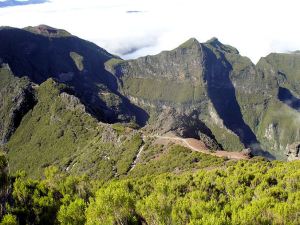
High above the world on Madeira’s peaks
Walking researcher/residents Shirley & Mike Whitehead know the island intimately and have followed up their Volume One book of 40 ‘Leisure Trails’ with a new Volume Two, tackling challenging trails and high altitude routes.
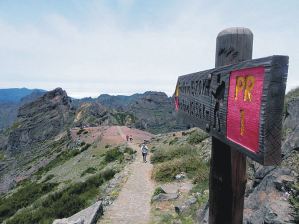
Pico Areeiro
If you’ve never visited this beautiful and dramatic island, you’re missing one of the world’s great walking destinations.
Mountains, levadas, tiny hamlets and towering cliffs; unique flora and ancient forests.
In around four hours by air from Europe you can escape the long cold tail of winter and revitalise yourself with strolls, walks and challenging hikes.
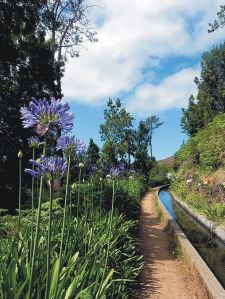
Levada Nova
Click HERE for more information.

La Palma – the World’s Steepest Island

Walk! La Palma – new 3rd edition
Authors: Charles Davis and Jan Kostura
ISBN 9781782750215 £12.99
La Palma is the most north-westerly and the steepest of the Canary Islands; arguably it’s the steepest island in the world.

Views to Pico de la Nieve (Walk 29)
If you’re looking for a walking destination that’s wild, beautiful and unforgettable, La Palma will not disappoint.
Here’s a sample map section; there’s one for each of the 37 routes, along with full walk descriptions, photographs and GPS information.

Pico Birigoyo, Cumbre Vieja, La Palma (Walk 7)

For more information about Walk! La Palma and the companion La Palma Tour & Trail Map see Discovery Walking Guides’ website.
Madeira: The Garden Isle – a new walking guide
 Enduring popular as a walking destination, Madeira remains a beautiful and breathtaking island.
Resident authors and researchers, Shirley and Mike Whitehead know it like the backs of their hands and have come up with 41 routes and trails ideal for the ‘leisure’ walker in this new publication Madeira Walks: Volume One.
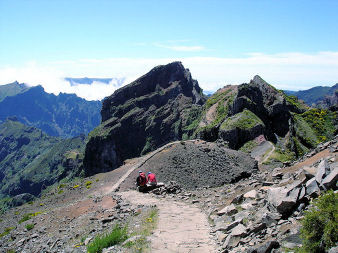
Volume 2 of this series will follow later in 2015 which concentrates on more challenging and high altitude routes.
All the routes are carefully described and are beautifully illustrated with images taken along each route.
Every route has its own highly detailed ‘Tour and Trail’ map section showing the route and waypoints clearly marked; research is done while carrying GPS  equipment to ensure accurate walking information.
For more information about the new book and Madeira Tour & Trail Maps and Madeira Bus Maps, take a look http://www.dwgwalking.co.uk/mad.htm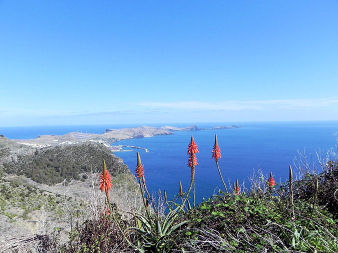
Gran Canaria – wonderful walking
 Thanks to Chris Kurton who has just had a wonderful walking holiday on the dramatic Canary Island of Gran Canaria.
Here’s one of Chris’ photos taken while walking; a view from a col towards Gui Gui.
See the GPS record of one of Chris’ routes, a circuit of Mount Tauro, http://connect.garmin.com/modern/activity/695801198/share/0?lang=en
See lots more images taken by Chris while walking the island in Walking The World group on Facebook; click https://www.facebook.com/groups/discovery.walking/
And for information on maps and walking on Gran Canaria see http://www.dwgwalking.co.uk/gcan.htm
Lanzarote – walking the Caldera Blanca

Wow! The interior of the crater, Walk 39, Lanzarote.
Our thanks to Robert and Penny, recently returned from walking on Lanzarote. Here’s what they told us:-
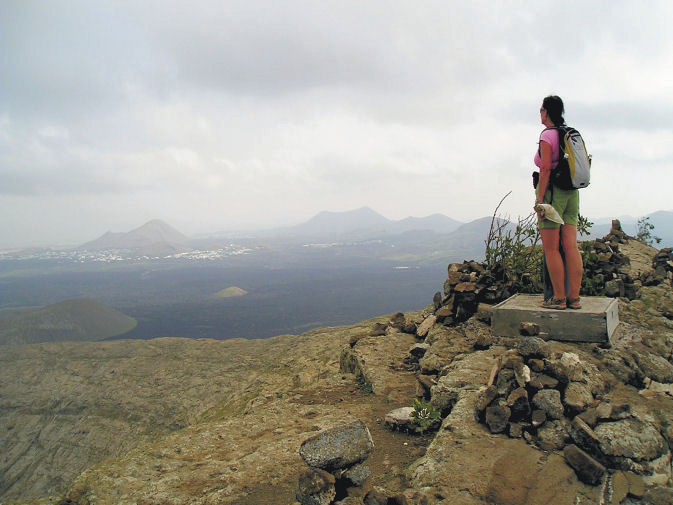
Standing on the volcanic crater rim of Caldera Blanca, Lanzarote.
We have just returned from 10 days walking in Lanzarote. Your book was a great help as there is little in the way of signs or clear path markers. Without your book we would have frequently got on the wrong
route.
One comment, on walk 39, Caldera Blanca, We agree this was a
fantastic walk and the view from the crater rim were fantastic.
However, if we were to do this walk again we would have gone round the
other way (anti clockwise). The decent from the top was much steeper
and the path was full of small stones which required great care to
safely negotiate. We would have been much happier going up that way.
We walked in La Palma a few years ago and again found the guide great.
Thanks again for a great guide.
Robert and Jenny P
Fuerteventura – the wild, windy desert island
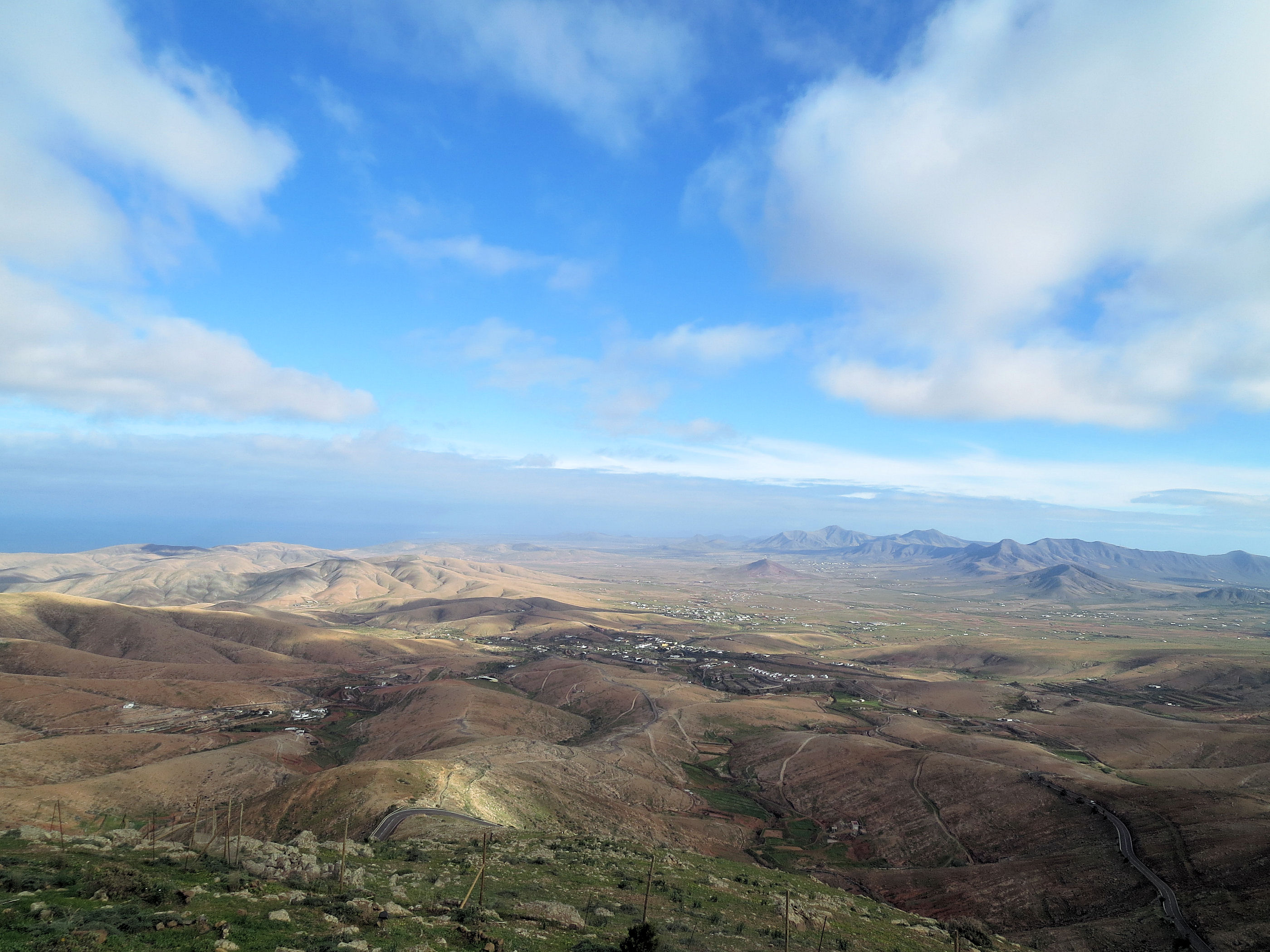
A surreal, wild and mostly empty landscape
We’ve just returned from completing a cartographic survey of this surreal island. Once your eye and mind adjust to the fact that most of it is a vast, volcanic desert, you begin to appreciate its surreal beauty.
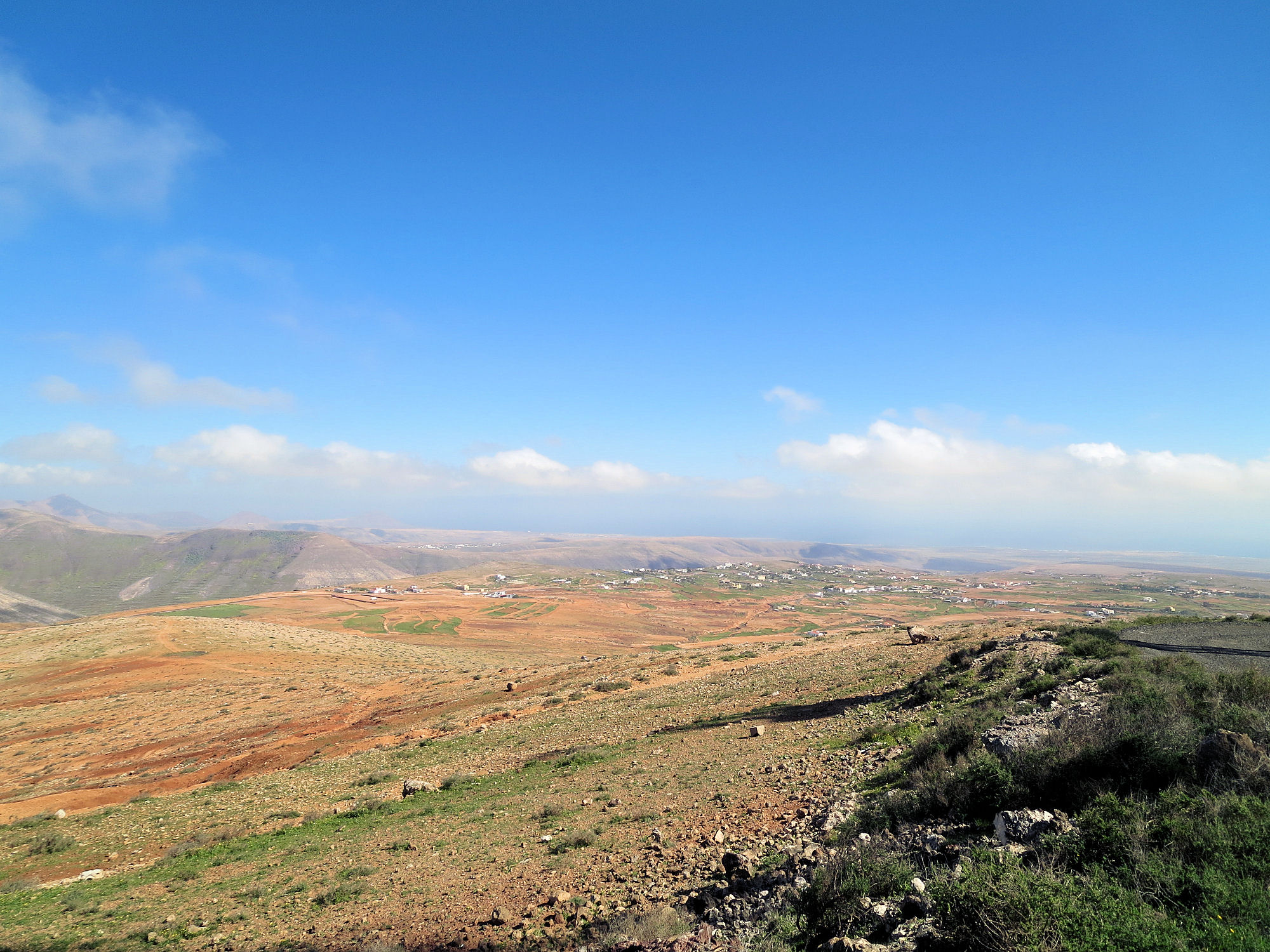
Central north Fuerteventura from the settlement of Time.
There are few towns and settlements, so if volcanic cones, calderas and barrancos are your thing, it is a ‘must-see’ destination.
Fuerte+ventura translates as ‘strong wind’ and this eastern Canary Island lives up to its name.
No wonder, then, that the island pulls in watersports people from all over the world, enjoying the challenge of the winds alongside the serene beauty of miles and miles of pure white beaches.

Watersport heaven on Fuerteventura’s east coast
The island has a long history. Wandering the streets of the original capital of Betancuria (founded 1405) is a journey back in time.

Established in 1405, Fuerteventura’s origianl capital of Betancuria is a step back in time.
Get up high on one of the mirador viewpoints to see amazing views of the scattering of volcanic cones with a few precious patches of green in the valleys. There’s very little rainfall here so agriculture is an uphill battle.

Aloe Vera thrives in Fuerteventura’s desert conditions.
Goat farmers (delicious white local cheeses) and growers of aloe vera are more in tune with the harsh terrain and climate.
Now we have the raw data, our cartographer David is working on Discovery Walking Guides ‘Fuerteventura Super-Durable Map’ which we hope to publish in April 2015.
Walking on the Canary Island of La Gomera? Updates December 2014

On La Gomera – Tenerife’s Teide visible
Winter is a great time for walking in the Canary Islands. La Gomera is easily reached yet remains wild and natural with breathtaking scenery and the winter weather is usually fresh yet gentle, with plenty of blue skies; though there can be periods of rain it rarely lasts for long.
We thank Pamela and Malcolm Boura for these useful and detailed notes they made on their visit there this December; they were using the guidebook Walk! La Gomera and La Gomera Tour & Trail Map.
All of the new paths and those missing from your map, referred to below, are shown correctly on OpenStreetMap. You may need to use an editor to look at some of the tags for detailed information such as tarmac/unpaved.
Walk 1
Start of walk: OpenStreetMap shows a path running from a little way down the path to La Laja to Wp2. We did not walk this but the west end looks good and it looks clear on aerial photographs. It probably provides an alternative to the road. According to some rather uncertain contours, it adds about 30m of ascent.
Easy route first paragraph: new path avoiding buildings and noisy dogs to Wp5, see OpenStreetMap. Adds a few metres of ascent but is shorter and is the signed route.
We walked the first part of Walk 1 as the start of Walk 2.
Walk 3
If the start of this walk is not in La Laja, part of the descent to and ascent from the village can be avoided by taking a good donkey path, with fine views of the village, which starts as you cross the spur after Wp16 and emerges to rejoin the main route at the last houses of La Laga, where the sculptures are, after Wp2. This good and useful path is not shown on your map. See OpenStreetMap.
Walk 8
We think this walk should be done in reverse with the steeper and rougher paths as ascent and then the long, fast, gentle descent for the return. Climbing up Barranco do los Cocos would also be much safer than going down, especially in rain, as well as giving a better opportunity to appreciate this lovely valley.
The start of this walk in Playa Santiago has changed after recent works on the river bed. Now follow the east bank until scrambling up the road embankment at the end of the track at Wp2. The first zig and zag are tarmac. Alternatively, parking is available at the adjacent rest area.
There is a clear signposted path branching left before Wp7 which leads directly to the new wooden bungalow. This avoids the final part of the climb towards Targa and the short length of road. This good and useful shortcut is not shown on your map.
Walk 22
The track up Barranco del Valle Gran Rey at present can not be accessed from the lane which starts behind the bus station. This may be temporary.
Walk 23
We walked this in reverse and the start in this direction is confusing and needs instructions. Suggest “A few metres after leaving the road, head right up some rough rock cut steps.”
Walk 25
Some of the “path” is washed away crossing the gullies between Wp2 and Wp3. OpenStreetMap shows a path directly from the start to Wp6 which may provide a better alternative.
Just before reaching the road at the top of the barranco, the path goes to the north of the summit. This is not obvious on the ground and it is shown incorrectly on your map. The route shown on your map goes across a steep and dangerous hillside. See OpenStreetMap.
At Wp17, go slightly left across the road to a painted waymark on the crash barrier. The path from there goes directly to the cemetery.
Taking the alternative route in the last paragraph on your walk, turn right down a track just before the dirt track reaches the road. When the track reaches the bamboo, turn left on an overgrown but passable path to emerge on the road where the path entrance is marked by a cairn. NB This is a new road not shown on your map.
See OpenStreetMap for the extra paths and roads.
Walk 29
We very much enjoyed this straight forward walk but where the track junction is shown on your map between Wp7 and Wp8, we took the track forking left which continues as a good signposted path running parallel to your route but avoiding the road. This leads directly to the saddle between Mt Bianca and the masts and then along the ridge to the masts. See OpenStreetMap. We saw the ends of paths that probably bypass the masts to the NE, cutting the corner.
There is a signposted junction to the west of Wp8, at N28 10.802, W17 17.708, but the signpost has been sited sufficiently far from the junction (a few tens of metres east) to be misleading, especially if doing the walk in reverse. This needs checking on the ground before more can be said, as there were signs of a rough path north from the signpost, although I suspect that was due to people that had been misled!
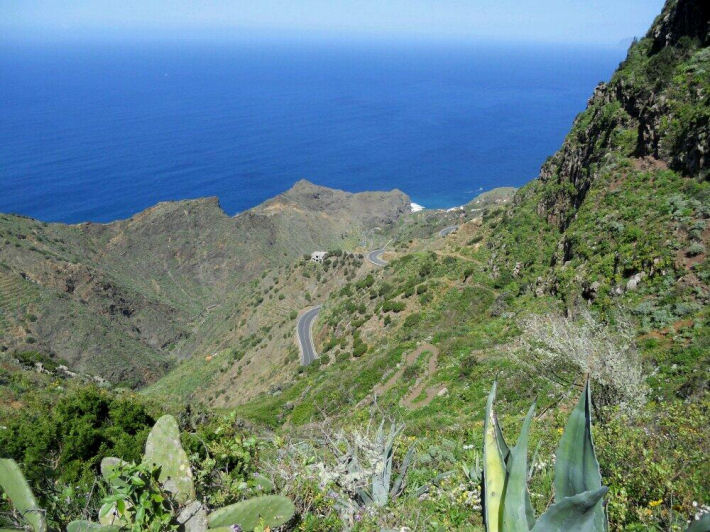
La Gomera – on Walk 31 (from Walk! La Gomera by Charles Davis). Image courtesy of ‘Inspire Our Trip’.
Walk 31
Unfortunately, the dirt track up Barranco de la Palmita has become a tarmac lane for much of its length. See OpenStreetMap for details of which bits (you may need to look at the editor information to get details of the surface).
The Garden Isle of Madeira – escape from winter!
Winter has finally arrived in northern Europe and the days are short and dark. It’s the ideal time to enjoy Madeira. Lush vegetation, mountains and levadas await your discovery.

Aloe aborescens

Madeira Tour & Trail Map
Discovery Walking Guides have released their 8th editions of their Tour & Trail Maps to the Garden Isle (a choice of map-paper or Super-Durable polymer). Walkers keep on buying these for their accuracy, clarity and wealth of up-to-date detail.
Ask for them in your favourite bookshop or get them online from your choice of stockists.
Here’s a link to amazon UK’s information page about the Super-Durable edition:

La Gomera – thanks to ‘Inspire Our Trip’
La Gomera – on Walk 31 (from Walk! La Gomera by Charles Davis). Image courtesy of ‘Inspire Our Trip’.
‘Inspire Our Trip’ on twitter said:-
“Brilliant hike and a great day walk. Thank you Charles Davis for Walk 31.”
Charles Davis is the author of Walk! La Gomera:- see http://www.dwgwalking.co.uk/walkla.htm
https://twitter.com/InspireOurTrip/status/455766577577988096/photo/1
Mallorca: Update on the GR221 – thanks Eryk Grant
These notes were sent by Eryk Grant re the GR221, while using Charles Davis’ book ‘The GR221 – Mallorca’s Drystone Way’
http://www.dwgwalking.co.uk/mallGR221Spec.htm , notably the stretch between Esporles and Valldemossa.
“Hi Charles
Walked this section last Sunday (6th April) without any problem.
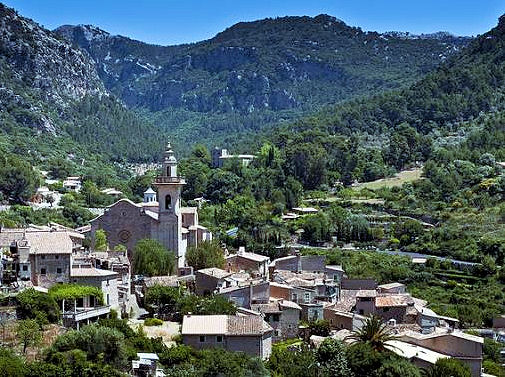
The Mallorcan town of Valldemossa
There were five other walkers on the route and it looks like the obstructions placed by the landowner (notices and fence) are largely ignored. I saw no attempt to ‘repair’ the fence and it was easy to negotiate-there are cairns galore and helpful green/yellow spots on rocks. The track has not become overgrown suggesting it is really well used. There is also a shiny new GR route map in Esporles town centre showing the route going through and all the subsequent wayposts except one refer to it. I guess there may be some tacit acceptance that walking will continue and I would not hesitate to walk this part again.
Up by the Tossals refuge there is a fair amount of building material but not much sign that anything is happening! Last time we stayed there in 2012 we had a conversation with a Dutch couple who were using your DWG guide, and making their way based on “what does Charles say?” – your directions and supporting commentary have never let us down either and in fact have really added to the enjoyment in places.”
Thanks Erik – feedback from walkers who’ve been there is valuable both for those who come after you, as well as providing us with valuable information for new editions.
 discoverywalking