
Brittany’s North – Wonderful Walking
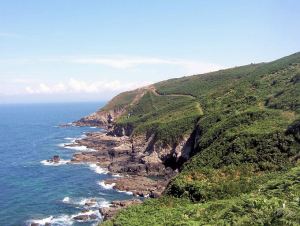
Rollercoaster walking on Walk 10, Plougasnou
How do you like the sound of walking through bucolic countryside, or discovering an orchid-lined pilgrim’s way?
What about exploring a fairy-tale trail winding through ancient woodland, or strolling alongside an idyllic trout stream?
You could be scrambling across a cataract of rocks or following the airy contours of the spectacular coastal path, weaving between delicately sculpted dunes or wandering across the flat sands of the tideland.

Port de Ploumanach on Walk 19, Ploumanac’h
Gaze at the wide blue horizon from a wind battered headland or simply lounge about on a breathtakingly beautiful beach.
Brittany, (north-western France) is a perfect ‘get away from it all’ experience.
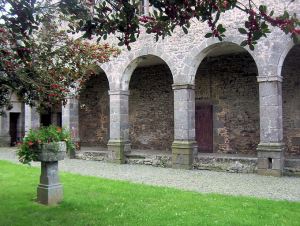
Abbaye du Tronchet cloisters, Walk 37

Rolling pastures on Walk 32, Langast
Boasting more than 3,000 kilometres of waymarked paths, a tourist infrastructure that is highly developed without being obtrusive, and regular budget flights, the region has all you need for a long-weekend away or a full walking holiday.
If walking in Brittany has you intrigued, we recommend you take a look at experienced walker/researcher/author Charles Davis’ guidebook, Walk! Brittany North.
There’s more information on Discovery Walking Guides’ pages also.
Mallorca; sun, sea, mountains – and Bird Watching too

On Mallorca’s north-west coast
Say ‘Mallorca’ and most people think, “Sun, beaches, mountains, walks, sea-food, sangria …..

Avocet
There’s another excellent reason for visiting this beautiful Balearic island, set in the blue Mediterranean.
Mallorca is home to a surprising number of bird species and acts as a passing-through stop-off for even more bird groups.

Bee-eater
The island’s varied geography, from coastal cliffs to rugged mountains, from wetlands, reservoirs and coastal areas, offer bird life of many kinds a welcoming place to live, rest, feed and breed.
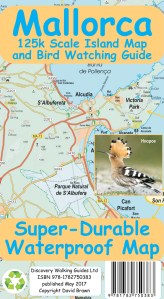
It’s an excellent and up-to-date detailed map (waterproof, tear resistant and guaranteed) perfect for touring the island, with a wealth of details such as best beaches, picnic areas, miradors – plus the locations of the best bird-spotting places.
The map reverse details 51 bird species together with photos and ID information.
Corfu – One in 6000
With approximately 6000 Greek islands and islets to choose from, why Corfu?

Just one of Corfu’s beautiful bays.
Well, it’s a lush green island with white beaches and azure seas, diverse landscapes and a long history, offering lovers of nature, Greek culture and
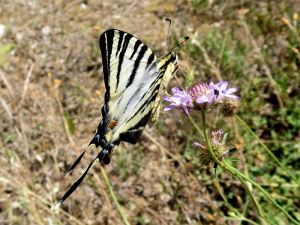
Rare Swallowtail, Corfu
water sports alike an unforgettable experience.
The coastline provides many ‘wow’ moments, with plunging cliffs, picture-postcard bays and inlets and impossibly blue seas.
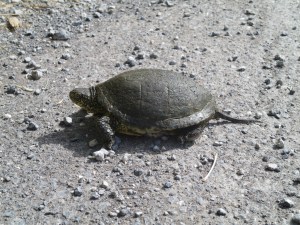
Wild Tortoise, Corfu
Corfu has an enduring relationship with the sea, each sheltered inlet and harbour home to fishing boats or pleasure craft.
You’ll find plenty of choices on offer if you want a trip around Corfu’s dramatic coastline, best viewd from the water.
Of course, there are wonderful seafood restaurants, many modestly priced especially away from the resorts.
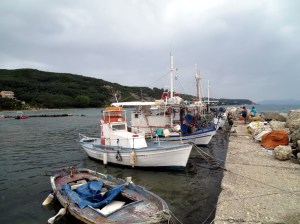
Lefkimis Bay, Corfu

The Kaiser’s Throne, Corfu
The mountainous north rolls down towards the south, cypress forests cloaking the hillsides while ancient olive groves and fruit orchards thrive at their feet.
There are walking trails and paths, with the icing on the cake being the Corfu Trail which you can choose to do in part or tackle the whole thing.

The ‘main road’ through Ano Korakiana, Corfu.
There’s a sprinkle of ancient, sleepy villages resonating with the island’s long history. If you’re driving yourself through in a hire car, prepare to breathe in!
Back in June 2016 we posted ‘Corfu – An Island In Need Of A Good Map’. Good news – here it is!
 Just published, this is the perfect map, whatever you plan to do on this lovely Greek island.
Find the best beaches and places of interest. Follow the Corfu Trail in whole or part). IF you plan to drive, this is the most up-to-date map showing all roads and junctions.
Corfu – once visited, never forgotten.
Island Hopping – Twice The Adventure Nº2 – Tenerife to La Gomera
Hop From Tenerife to La Gomera
There’s no doubt that Tenerife is one of the most popular island destinations, easily reached in around 5 hours from much of Europe and enticing with sunny skies, warm temperature, beaches and mountains and (if you want it) plenty of nightlife.

Looking down to San Sebastian (La Gomera), Pico del Teide on Tenerife in the distance
If you fancy a complete contrast, sample a day on the island of La Gomera, so close to Tenerife yet oh! so different – rugged, shaped like a well-risen circular cake topped by ancient laurel forests and with mighty ravines slicing down to the sea.
It’s laid back, offering astounding views and walks, little tipico cafés and restaurants, flamboyant plant life and stunning geology. Oh, and it has beaches.
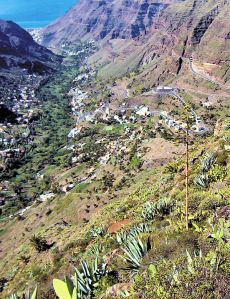
Valle Gran Rey, La Gomera
Frequent ferries mean you can be there in under an hour from Los Cristianos, Tenerife, landing in Gomera’s capital San Sebastián, where public buses await in the harbour to take you onward. Car hire ofices and taxis are located here too.
Journey time: The fastest crossing from Tenerife to La Gomera goes via the harbours Los Cristianos de Tenerife to San Sebastián de La Gomera. The Benchijigua Express Ferry covers this distance in about 50 minutes. Other (slower) ferry services are offered by Naviera Armas. Pre-booking is essentail.
What to do? In one day, you’ll need to be selective. Take a look at these Trip Advisor suggestions.
For lots more information about La Gomera, including maps, look here.
There’s a brand-new edition of Walk! La Gomera, just published; look here.
Island Hopping – Twice The Adventure
Day Trip – Island Hopping Nº1
Going to Lanzarote? Hop to Fuerteventura!
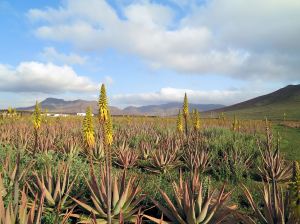
Aloe Vera thrives in Fuerteventura’s desert conditions.
You’ve planned your trip to Lanzarote, booked flights, accommodation and maybe a hire car.
Why not plan a day trip to the next island south too, just a 25 to 45 minute ferry trip away?
Fuerteventura is Lanzarote’s big sister and has its own personality. Watersports are big here (think Fuerte+Ventura = Strong Wind) and there are biking and hiking routes too. Or hire a car for the day and take a look. At about 100 kilmetres in length, it’s too big to see everything in just one day, though you’ll get a taste of the place and may want to return for a longer visit.
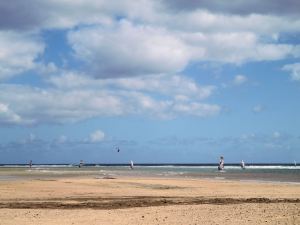
Watersport heaven on Fuerteventura’s east coast
Things to do – Trip Advisor has good suggestions for beaches, cafes, museums and watersports.
It’s useful to get hold of a good map before you go. Take a look at this link for up-to-date map information:
http://www.dwgwalking.co.uk/fuerteventura.htm

Established in 1405, Fuerteventura’s origianl capital of Betancuria is a step back in time.
There’s a useful website for those wanting more information about hiking and biking on Fuerteventura; take a look at:
Madeira – news just in – Levada Nova
Thanks to Peter and Ginny, just back from a walking holiday on the isle of Madeira, we are passing on their update:
“Levada Nova has had rock falls along an extensive section near the start so that virtually all the safety barriers have disappeared. This makes the walk dangerous! We tried to carefully continue thinking the damage would be limited to a short section but it seemed to go on for a long distance so we turned back.”
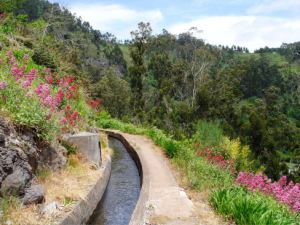
Levada Nova, Madeira (Walk 73)
Levada Nova is a popular walking route; if you are using Madeira Walks Volume Two, it is Walk 73.
Do check before setting out, either by asking at Tourist Offices or by looking on the island’s official website walking pages.
Are You Off To Walk Madeira? Check Before You Walk.

Aloe aborescens clinging to Madeiran cliffs
Madeira! What a great desination, especially at this time of year.
Swapping the dark and cold of Northern Europe for Madeira’s green and spring-like mountains is a popular choice at this time of year.
If you are planning to walk there, it’s worth checking that the paths you’re planning on following are open. The best place to look for information is on the official ‘Visit Madeira’ tourism website. To see which routes are open or temporarily closed, LOOK HERE.
If you are already on the island, you can also ask in Tourist Offices who usually have up to date information on walks that are open/closed.

A spectaculat waterfall on the Levada da Ribeira da Janela
At the moment only three of the official routes are temporarily closed. The authorities are vigilant and usually restore routes quickly; often, the problem is a landslip after heavy rain.
The three routes to avoid at the time of writing this are:
PR1 – Vereda do Areeiro
Temporarily closed
PR12 – Caminho Real da Encumeada
Temporarily closed
PR19 – Caminho Real do Paul do Mar
Temporarily closed
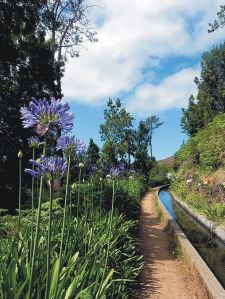
Levada Nova, Madeira
There’s so much great walking on Madeira that you’ll find plenty to tempt you, from strolls to all-day high altitude challenges. Even if you aren’t keen to do much walking, it’s a great idea to use the local buses which give you brilliant (sometimes a bit hairy!) adventures around the island for pocket-money prices.
There’s a great bus map available, also really useful as a driving map; LOOK HERE for details of the Madeira Bus & Touring Map.
For more information including details our two Madeira Walks guidebooks Madeira Tour & Trail Map and digital mapping for Madeira, take a look at Discovery Walking Guides; Madeira pages.
Lanzarote; rains bring the desert to colourful life!
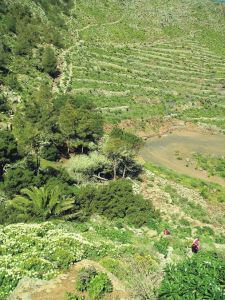
Barranco del Malpaso, Lanzarote
Residents on the Island of Lanzarote tell us that more visitors than usual have been enjoying the great outdoors on this unique island during November and December this year. The dramatic volcanic landscape is unforgettable, though is usually desert-dry with little natural green to see.
It doesn’t rain much (or often) on this arid Canary Island, so recent falls have been most welcome, bringing colour and plant life back to otherwise arid areas.

Helechos, Lanzarote
What a great time to visit! Warm days and sunshine (average of six hours per day in December, even more in January), plus the chance to see the colourful green swathes and flower carpets that happen for only a few weeks each year. Walk, hire a bike or car, or jump on a bus.
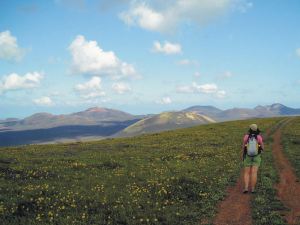
La Geria, Lanzarote
There’s plenty of interesting information about the island on the Lanzarote Information website; use the link below.
Take a look at the really useful Lanzarote Information website.
For more on this fascinating and often surprising island, including printed and digital mapping and walking information, take a look here:-
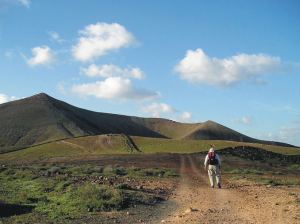
Montaňa Corona, Lanzarote
Beaches, Snow-Capped Mountains and Wonderful Walking – has to be Tenerife

Majestic Mount Teide, Tenerife
One of the great things about Tenerife is that you can enjoy the snow-capped peaks in the morning and have time to watch the sun go down from a warm, sunny beach that same day.
If you like lively resorts, Tenerife has them; if you prefer quiet settlements and small towns, you’ll find plenty of choice also.

Tenerife Bus & Touring Map
The bus service on the island is pretty good. If you have to drive while back in your ‘real life’, it’ll be so relaxing to discover Tenerife by bus.
If you want to drive, there are car hire companies galore.
And the walking – it’s varied and surprising. If you fancy country strolls or want to scale the mighty Mount Teide (or anything in between), Tenerife will not disappoint you.
Tenerife’s south is drier than the north, mostly due to massive Mount Teide dominating the island’s centre and affecting the island’s micro-climates.
Teide stands above the vast volcanic peaks and plains of Las Cañadas. The easy way to get to this highest point on Spanish territory is via the exciting cable-car ride. On A clear day you’ll see for many kilometres with fine views of some of the other Canary Islands.
The verdant north includes the capital of Santa Cruz, home to some fine old buildings and modern shopping. One of the original resorts, Puerto de la Cruz, sits on the north coast with plenty to
occupy visitors. Further west along the coast lies the ancient settlement of Garachico. It’s a fascinating old town with an unusual black natural rock-pool coastal area and a swathe of petrified lava remaining from Mount Teide’s eruption in 1706.

The Anaga, Tenerife
To the north-east is the wild area of Anaga, a walker’s delight.

Masca, western Tenerife
Dramatic and extreme geology on the west coast makes for plenty of ‘wow’ factor. The tiny settlement of Masca has to be seen to be believed though only drive yourself there (and back) if you have nerves of steel and no fear of narrow, winding mountain roads.
Los Gigantes is farther down the west coast, a larger and more modern settlement with a huge vertical set of cliffs plunging seawards with a narrow beach at their feet.
Inland from the west coast are walking paths and small settlements far from the tourist crowds.

Inland from Tenerife’s west coast
The sun-baked south of the island offers wide choices of accommodation, beaches, night-life, sports facilities and shopping. There are also some great walks in this region too. For more information about the island of Tenerife take a look at Discovery Walking Guides’ website
There’s a brand-new edition of the highly recommended Tenerife Hikers’ Maps, out now. Find out more by clicking HERE.

Tenerife Hikers’ Maps (3rd Super-Durable edition)
Choosing A Winter Walking Destination
What do you need for an enjoyable walking holiday when winter closes in on the northern hemisphere?
RELIABLE WARMTH AND SUNSHINE
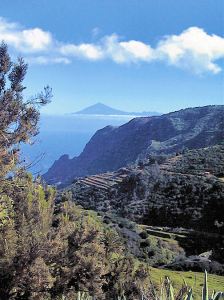
On La Gomera – Tenerife’s Teide visible
A 5 hour flight south (from the UK) gets you to the Canary Islands, off the coast of Africa. You can expect about six hours of sunshine per day (average) with highs of 20C in December though of course there are variations depending on the island and location.
Levada Nova, Madeira
Madeira is a bit closer and almost as sunny (around 5 hours) and almost as warm though the chance or rain is higher. That’s why Madeira is so green and floriferous!
A GOOD CHOICE OF HOTELS, NIGHT LIFE, SHOPS and RESTAURANTS
The Canary Islands and Madeira don’t really have a ‘closed’ season for tourism so you will find a wide range of accommodation, eating places, shops and night life. There are quieter, smaller places to stay if you want to get away from the ‘bright lights’.
EASY TO GET TO
There are plenty of flights all year round to the Canaries and to Madeira.
WHAT’S THE WALKING LIKE?
Each of the Canaries is unique, offering a wide choice of walks and challenging hikes. If you are looking for a pleasant stroll for an hour or two, a coastal discovery route or a full day in the mountains (or something inbetween), the Canaries are an ideal choice.
Madeira is rugged and steep, though the many levada walks (mostly level walks alongside narrow water canals) make it a walking destination with plenty of choice for all.
FIND OUT MORE ABOUT CANARY ISLANDS WALKING HERE:-
FOR MORE ABOUT WALKING ON THE GARDEN ISLE OF MADEIRA, LOOK HERE:-
Madeira
 discoverywalking